The Case Against The All-In-One HR Suite
A growing company does not necessarily need every HR function on day one. A five-person business may need leave management and employee records. Later, it may need recruitment, expenses, training, performance management, or workforce analytics. Yet conventional HR platforms often ask smaller businesses to buy into a large system before they actually need one.
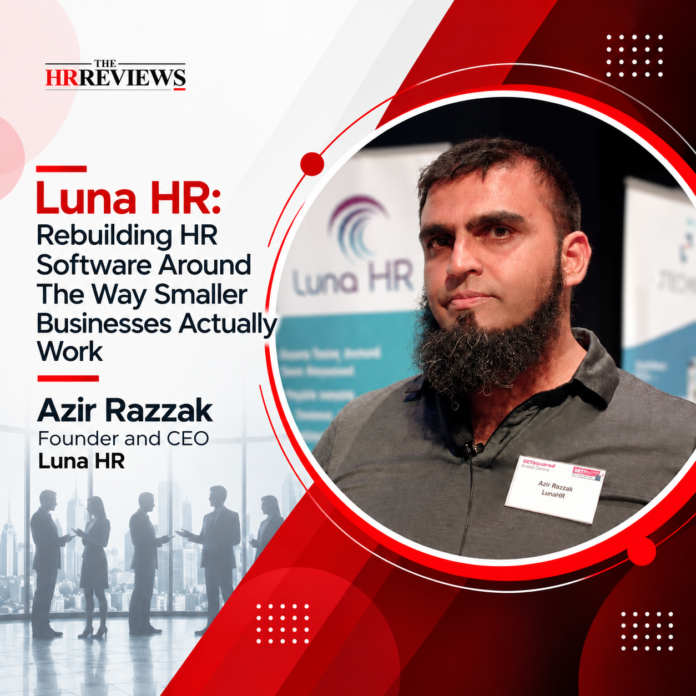
That is the gap Azir Razzak, Founder and CEO of Luna HR, set out to address. Based in Bristol, Luna HR is the commercial successor to an earlier HR platform developed by its parent company, A2Z Technologies. The team had spent more than a decade building software for UK businesses before developing Luna as a modern platform for small and medium-sized organizations.
The company’s proposition is deliberately different from the traditional all-in-one model. Luna HR is modular. Businesses can select the functions they need, leave others switched off, and add capabilities as their requirements change. The company specifically targets UK SMEs adopting or operating with remote and hybrid teams, a segment it believes has frequently been served either by enterprise products or simplified tools that lack the flexibility growing organizations eventually require.
This is less a feature decision than a philosophy. Luna is effectively arguing that HR technology should adapt to the organization rather than forcing the organization to adapt to the software.
Start Small. Build Outwards.
The modular approach changes how Luna HR can be introduced into a business. Instead of implementing a complete HR environment at once, an organization can begin with a specific requirement and expand the system when another need emerges.
The company’s pricing model reflects the same principle. Luna states that its base platform costs £2 per user per month, with individual modules available for an additional £0.50 per user, or the complete collection available for £5 per user. Teams with fewer than five employees can use the platform without charge. The company also states that there are no hidden fees or annual lock-ins.
Its modules cover areas including leave, expenses, training, security awareness, performance, wellness, assets, and recruitment. Recruitment, for example, includes job postings, a branded careers page, candidate pipelines, customizable application fields, interview scorecards, and automated actions. Once a candidate is hired, Luna can trigger onboarding activities, contract signing, and other processes without requiring the employee information to be manually recreated in another system.
That connected approach becomes particularly useful for organizations where HR responsibilities are shared between managers, finance teams, operations staff, and business owners. Instead of building separate workflows around each function, Luna attempts to create one underlying structure that different departments can use.
The Architecture Behind Luna
Modular By Design: Companies can activate only the HR functions they currently require.
UK-First: The platform is built around UK employment practices, HMRC requirements, bank holidays, and local HR processes.
Connected Workflows: Recruitment can flow directly into onboarding, while approvals and employee processes remain connected.
Flexible Policies: Company-wide rules can be inherited and then adjusted for specific offices, regions, or departments.
Conversational HR: Luna AI allows employees and managers to ask questions about company information and carry out selected HR tasks through conversation.
Where Software Meets The Real Workplace
Luna’s UK-first approach becomes more interesting when applied to the less glamorous details of everyday employment.
Mileage claims, for example, are not simply treated as generic expenses. The platform incorporates HMRC mileage rates and applies the relevant thresholds and rates. UK bank holidays are pre-loaded for England, Scotland, Wales, and Northern Ireland, while leave calculations can account for different working patterns.
The company has also developed functionality for businesses whose employees spend much of their working lives away from desks. Its sector offering for haulage and logistics includes driver certification management, vehicle and equipment tracking, mileage claims, shift-based leave, and approval delegation. Driver records can include certifications such as CPC and ADR, with expiry dates and renewal reminders.
This illustrates an important aspect of Luna’s strategy. Rather than treating every business as an office full of employees working identical schedules, the platform can be configured around different operational realities. That flexibility extends to approval chains, where requests can move through multiple managers, finance teams, directors, or HR fallback routes depending on how an organization is structured.
Putting The Human Back Into Human Resources
Luna’s wellness functionality pushes the platform into another area where HR technology needs to be handled carefully. The system includes anonymous pulse surveys, wellbeing check-ins, and safeguarding case management. Survey responses are aggregated, with minimum-response thresholds designed to prevent individual employees from being identified through small datasets. Safeguarding cases can move through defined stages with assigned owners, priorities, and audit trails.
The company’s approach to AI follows a similarly practical direction. Luna AI is designed around UK employment law and company-specific information, allowing users to ask questions about areas such as leave, HMRC rates, working-time requirements, and GDPR. Managers can also use conversational interactions to check information or carry out selected administrative tasks.
For Razzak and the team behind Luna, the objective is not to create another enormous HR suite. It is to make HR software more adaptable, understandable, and relevant to the businesses that are often overlooked by enterprise platforms.
That philosophy is reflected in Luna’s own principles: clear and practical, modular rather than monolithic, UK-first, supportive, transparent, and built to last.
In a market where HR software can become increasingly complicated as more features are added, Luna HR is taking a different route. Its proposition is based on giving businesses permission to start with what they need, expand when they are ready, and configure the system around the way their organization actually operates. For smaller UK businesses, that may make the software less of a system they have to accommodate and more of a platform that grows with them.