


Built By People Who Had Already Seen The Problem
Before Vitae became an AI recruitment platform, its founders had spent years working inside recruitment technology. They had implemented systems for recruitment agencies, background-screening businesses, government organizations, and in-house hiring teams. That experience gave them a detailed view of where recruitment software worked, where it became cumbersome, and where recruiters were still doing work that technology should have been able to handle.
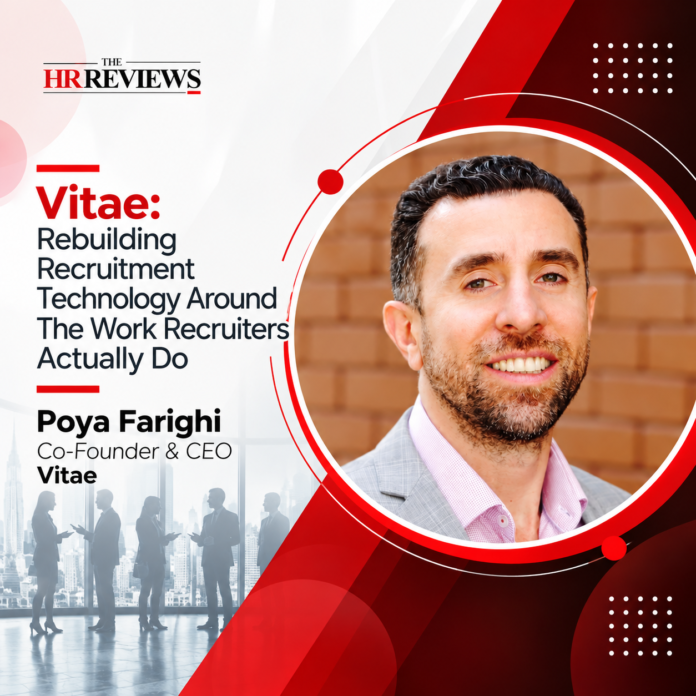
Poya Farighi, Co-Founder and CEO of Vitae, brought particularly deep experience to that challenge. He is a second-time recruitment-technology founder and previously built and sold a recruiting software company to private equity. Alongside Co-Founder and CTO Vincent Tellier, he set out to build a new generation of recruitment technology around artificial intelligence and the practical realities of modern hiring.
Vitae’s first version launched in early 2025. The company is headquartered in London and has developed a user base spanning multiple countries, serving recruitment agencies, executive-search firms, RPOs, and internal recruitment teams. Its founders describe the platform as the suite of tools they wished they had throughout their careers in recruitment technology.
That origin story matters because Vitae is not approaching AI recruitment as an abstract technology exercise. Its product is being developed around the specific tasks that recruiters perform every day, from sourcing and candidate engagement to workflow management and administrative coordination.
The Recruiter Does Not Need Another Dashboard
Recruitment technology has accumulated layers of functionality over the years. Applicant tracking systems organize candidates. Recruitment marketing tools manage campaigns. Sourcing platforms identify potential applicants. Communication systems handle outreach. Analytics platforms measure activity.
The challenge is that recruiters still have to move between these systems and manually coordinate many of the actions taking place between them.
Vitae’s approach is to put AI agents directly into those workflows. Rather than positioning AI as something that simply answers questions, the company is building technology capable of taking actions across recruitment processes.
That distinction changes the role of the software. A conventional recruitment platform might tell a recruiter which candidates are available. An AI-native platform can potentially take the next steps, such as organizing information, preparing communications, updating records, or moving a workflow forward.
Vitae’s platform is designed to support different recruitment business models rather than forcing agencies into a rigid operating structure. Its users include agencies, executive-search firms, RPO organizations, and internal recruitment teams, each of which can have significantly different processes and commercial requirements.
Inside Vitae’s Approach
AI Agents: Technology is designed to perform recruitment tasks rather than simply provide conversational assistance.
Recruiter-Centric Development: The platform is being developed by people with extensive experience inside recruitment technology.
Flexible Workflows: The system is designed to adapt to different recruitment business models.
Global Reach: Vitae has developed an international user base since its launch.
Human Expertise: AI is intended to augment recruitment professionals rather than eliminate their role.
AI That Works Alongside Recruiters
The company’s philosophy is particularly clear in the way it approaches human expertise. Vitae’s founders do not present AI as a replacement for recruiters. Instead, the technology is intended to take responsibility for repetitive work while leaving judgment, relationships, and important hiring decisions with people.
That distinction is increasingly important as AI becomes embedded in recruitment. Hiring involves more than matching keywords against résumés. Recruiters interpret career histories, understand client requirements, communicate with candidates, assess context, and build relationships that cannot always be reduced to a database field.
Vitae’s technology therefore focuses on the operational side of recruitment. By automating tasks around the hiring workflow, the company aims to give recruiters more time for the work where experience and judgment matter.
Its approach also places emphasis on transparency and explainability. The company describes its technology as incorporating bias-aware scoring and compliance considerations, while its platform was initially developed around the UK market with ambitions for international use.
Farighi’s role becomes particularly relevant here. His experience building recruitment technology before Vitae gives the company a perspective shaped by the evolution of the category itself. Rather than approaching AI simply as another feature, the leadership team is applying it to the practical tasks that have historically consumed recruiters’ time.
A New Generation Of Recruitment Infrastructure
Vitae’s recent launch is significant because the company is entering recruitment technology at a moment when artificial intelligence is changing expectations around productivity. Recruiters are increasingly asking not only whether software can store information, but whether it can actually complete work.
Vitae’s founders are responding to that shift with a platform built around action. Its development is closely connected to the team’s previous experience with recruitment systems, giving the company a specific understanding of the operational problems it is attempting to solve.
The company’s opportunity is therefore not simply to compete with established recruitment platforms feature for feature. It is to make a different argument about what recruitment technology should actually do.
Recruiters already have plenty of software. The bigger question is whether that software can remove enough repetitive work to give professionals more time for conversations, judgment, relationships, and decisions.
Vitae is building toward that model from London, combining recruitment expertise, software engineering, and AI agents into a platform intended for the people who actually operate the hiring process. Its ambition is ultimately straightforward: make recruitment technology do more of the work, while allowing recruiters to spend more of their time doing the work that technology cannot replace.