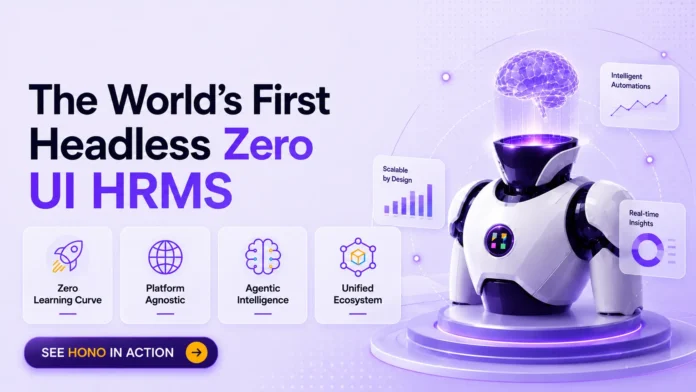


HONO.AI launched HONO AI Zero UI on May 7, introducing a headless HRMS for enterprise workforce management.
The platform replaces traditional HR interfaces with a conversational layer that lets users execute operations through natural language.
HONO said the system allows employees and HR teams to ask questions, trigger transactions, retrieve insights, and configure processes.
The launch reflects growing interest in simpler enterprise software that reduces navigation and training requirements.
The platform uses an intelligent execution engine to interpret user requests and select appropriate application programming interfaces.
Its AI agents provide contextual insights, while a knowledge layer supports responses using organizational information.
Enterprise controls include permissions management, compliance features, and data security capabilities.
The system also supports Model Context Protocol integrations with external artificial intelligence systems and enterprise platforms.
These capabilities position Human Resource technology closer to conversational enterprise software models.
HONO integrates the platform with Microsoft Teams, Slack, SAP, and Jira.
Users can therefore interact with Human Resource workflows through applications already embedded in daily workplace processes.
Multilingual support is designed for organizations managing geographically distributed and diverse workforces.
HONO said its architecture removes the need for extensive system onboarding and training.
This approach could help organizations address adoption challenges associated with complex HR software environments.
The platform covers the broader employee lifecycle, including core HR, global payroll, talent management, and workforce analytics.
HONO operates through legal entities in seven countries and serves clients across more than 30 countries.
The company said HONO AI is available globally for enterprise deployment following the May launch.
Its international positioning gives Human Resource leaders another model for evaluating globally scalable HR technology.
However, organizations still need to assess local compliance, integration requirements, security standards, and data governance.
For HR technology teams, the launch highlights a shift toward more accessible Human Resource systems.
Conversational interfaces can potentially reduce the steps required for routine HR transactions and information requests.
They may also allow employees to interact with HR services without learning complex application structures.
For multinational employers, integration across existing workplace platforms could further support consistent workforce processes.
Human Resource leaders will nevertheless need to evaluate accuracy, permissions, auditability, and human oversight when adopting AI-driven workflows.
The development signals continued movement toward HR platforms designed around user intent rather than traditional application navigation.
HONO Launches Headless HRMS to Modernize Human Resource Operations